Annonceur : Vous désirez amener votre entreprise à un autre niveau, vous démarquer et créer un contenu différent et original? Podcast Inc. est le podcast qu'il vous faut. Marco Bernard est l'expert qui a formé le plus grand nombre d'entrepreneurs francophones à démarrer leur propre podcast sur la planète. Il vous enseigne les détails du podcasting en profondeur et partage avec vous les secrets d'autres podcasteurs francophones. Bienvenue sur Podcast Inc. Voici votre hôte, Marco Bernard.
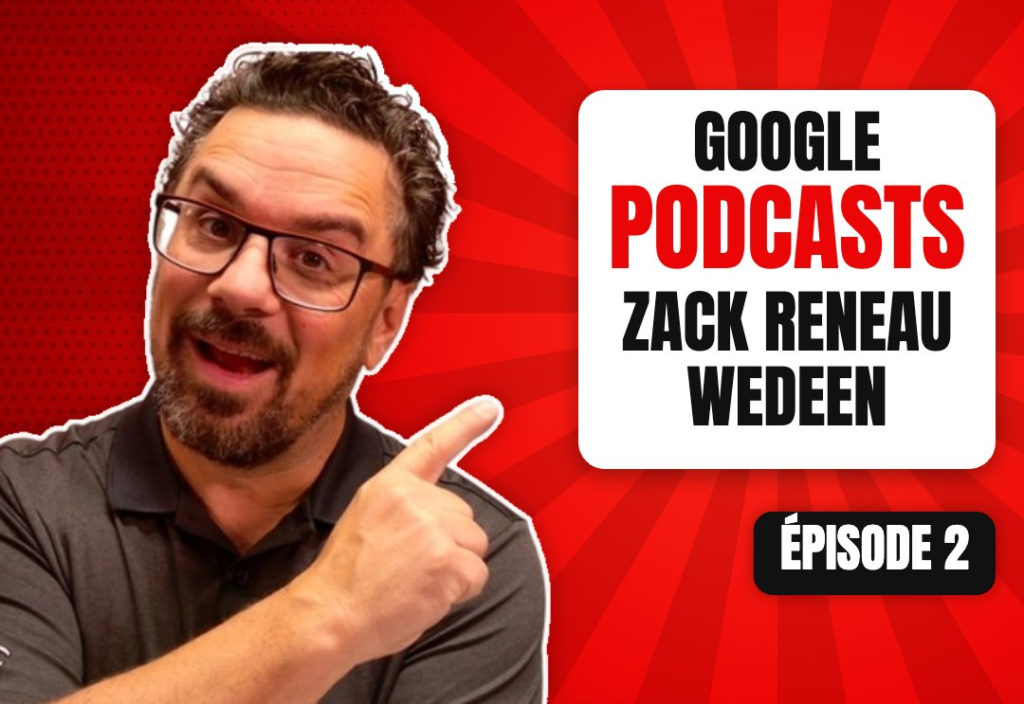
Marco : Salut tout le monde, et bienvenue dans cet épisode 002 de Podcast Inc., le seul podcast dédié à l'industrie francophone du podcasting. Que vous soyez en train de penser à vous lancer dans le podcast ou que vous soyez déjà un podcasteur expérimenté, vous y trouverez une foule d'informations et d'inspiration pour amener votre podcast à un autre niveau. Cette semaine, je suis très fier de vous présenter le directeur de Google Podcasts, Zack Reneau-Wedeen.
Quand je vous dis que je suis très fier, c'est d'abord parce que je l'ai rencontré à Philadelphie. C'est un être super sympathique, très disponible. On a eu un petit pépin lors de l'enregistrement : le premier enregistrement de l'épisode n'a pas fonctionné. Je ne sais pas ce que j'ai fait au moment de sauvegarder l'épisode sur mon téléphone, mais il ne s'est pas sauvegardé, et je m'en suis rendu compte seulement à mon retour à l'hôtel, à la fin de la journée.
J'ai écrit à Zack, on a essayé de se rebooker le lendemain, mais on n'a pas pu trouver de salle à Philadelphie. On a donc refait l'entrevue par la suite, par Zoom, comme je le fais habituellement. Il s'est rendu super disponible. C'était lors de l'événement Podcast Movement à Philadelphie, où il y avait 3 000 personnes et où Google avait de grosses annonces à faire. Zack était probablement l'homme le plus en demande de l'événement. Malgré tout ça, on a pu se parler à plusieurs reprises. Définitivement quelqu'un d'extrêmement sympathique.
Google a fait de très grosses annonces lors de Podcast Movement, entre autres qu'elle voulait doubler l'audience mondiale du podcast dans les 24 prochains mois. Plusieurs programmes ont aussi été annoncés. Il faut savoir que Google, présentement, c'est le deuxième plus gros joueur mondial au niveau du podcasting. Et c'est nul autre que le directeur lui-même qu'on a reçu.
Évidemment, cette entrevue sera en anglais. Mon anglais est très bon à l'écoute : je n'ai aucun problème à écouter des podcasts en anglais, j'en écoute énormément. Mais au niveau du parler, c'est so-so. Vous me pardonnerez donc mes questions dans lesquelles je bafouille à l'occasion. Je vais quand même vous faire le résumé de ce que Zack nous aura dit, en français, à la fin de l'entrevue. Restez jusqu'à la fin : si des choses vous échappent en anglais, je serai là pour vous donner le compte rendu.
Cette semaine, le podcast de la semaine. Comme à l'habitude, je vais vous présenter ma sélection, mais je vous invite à me faire part des podcasts que vous découvrez vous-mêmes, ou de votre propre podcast. Vous pouvez facilement le faire à parler@marcobernard.ca. Si vous voulez que je le mette en évidence dans Podcast Inc., ça va me faire plaisir.
Le podcast que j'ai choisi cette semaine s'appelle Choisir la liberté, d'Antoine BM. Antoine BM en est déjà à 154 épisodes sur son podcast, malgré une petite pause l'an dernier, ce qui est vraiment impressionnant. C'est un podcast bihebdomadaire au moment où on se parle, parce que la fréquence a changé en cours de route. Les épisodes durent en moyenne de 25 à 40 minutes. On y trouve des idées pour vivre de sa passion, simplifier son quotidien et vivre selon ses propres désirs.
Antoine BM est très populaire sur YouTube, entre autres, avec une très grosse chaîne. Vous pouvez aller jeter un œil là-dessus, mais le podcast, c'est définitivement quelque chose à découvrir, c'est vraiment intéressant. Je vous rappelle que vous pouvez me proposer vos coups de cœur, ou votre propre podcast, directement à parler@marcobernard.ca.
Avant de vous laisser à l'entrevue avec Zack Reneau-Wedeen, j'ai une petite invitation spéciale à vous faire. Vous êtes sûrement un passionné du podcast, n'est-ce pas? Et si vous m'écoutez en ce moment, vous êtes sans doute francophone. Le groupe Facebook de Podcast Inc. est l'endroit tout désigné pour discuter podcast et découvrir les dernières tendances du podcasting dans la grande francophonie mondiale. C'est l'endroit où les podcasteurs s'entraident pour faire avancer leur podcast, que ce soit pour des trucs techniques, de la recherche d'invités ou de l'entraide pour faire exploser son auditoire.
Pour y adhérer, rien de plus simple : rendez-vous au podcast-inc.biz/groupe et mentionnez le mot de passe privilégié, « Podcast Inc ». On se revoit là-bas. Ciao.
Marco : Zack Reneau-Wedeen, it's a great honor and a great pleasure for me to have you on the show. Thank you very much.
Zack : Thanks so much, Marco, for having me.
Marco : The launch of Google Podcasts happened in the last few weeks. Tell me what this app is bringing to the podcasting world.
Zack : For sure. We launched the Google Podcasts app back on June 19th, available for Android globally, in all languages. It's a new way to find and listen to the world's podcasts. At the beginning, the main difference you'll see about this app is, one, it syncs across your devices. It's integrated with the Google Assistant, so if you pause on your phone, you can resume on Google Home. And number two is personalized recommendations: as you use the app and listen to more podcasts, you'll start to see podcasts we think you'll like, based on what you've listened to and subscribed to already.
Marco : Okay, cool. You went bold on wanting to double the podcast audience in the next couple of years. What's the plan for Google to get there?
Zack : One of the main reasons we started with such a focus on Android is that there are over two billion people around the world using Android. We think that if we make it easier for them to find and listen to podcasts, we can make podcasts more accessible and more discoverable. Most of those two billion people don't listen to podcasts today, so improving discovery for them could have a big impact on the number of people listening. Our goal is to help double the worldwide listenership of podcasts.
Marco : So Google Podcasts would be installed directly on every Android phone, right?
Zack : The way it works today is that Google Podcasts is actually already on every Android phone, but it's available through the Assistant if you ask it to play a podcast. Also through Google Search: if you search for Radiolab, for example, you can play the podcast from the search page. And also through what we call a direct link, which a publisher can make for their podcast, and which opens the podcast in Google Podcasts on any Android phone today.
The listening across all of those surfaces is synced. It's all the same experience. What you have to go to the Play Store to get is the actual icon for your home screen. I think what you're asking is whether that icon will be default on Android. That's something we're exploring, in terms of talking to manufacturers, but it's not available today, and we have no concrete announcement about a particular plan there.
Marco : Okay. Same thing for Apple devices, I guess, because right now Google Podcasts is not available in the Apple store, right?
Zack : That's correct. The app is only available on Android.
Marco : Is there any resource the podcasters listening right now can find to make sure their podcast is available on Google Podcasts?
Zack : Definitely. We have a podcaster toolkit, which I showed you when we met a few weeks back at Podcast Movement, and which was in the tote bag everybody got. There are a bunch of links on it, which we can include in the show notes for this episode: g.co/podcast/links to make a direct link, and g.co/podcast/dev to read our developer guidelines. I also tweeted out screenshots of the toolkit, so that's another way to find it. It has some best practices about how to promote your podcast, because the more you promote your podcast, the more likely it is to end up in those recommendation carousels, as a popular podcast, a trending podcast, or something that people who listen to podcast X might like.
Marco : Sure. We'll put these links in the show notes. You announced at Podcast Movement in Philly that MP3 files will soon be searchable directly from the audio content inside the file, and not only based on the title or the description as it is right now. How will that work?
Zack : We've been asked a lot why Google is getting into podcasting, and why now. The big reasons are, number one, the opportunity on Android, which we already talked about. But the other big reason is that we see some of Google's strengths lining up really well with what will help the podcasting industry move forward. Specifically, we think discovery is something where we can add a lot of value, especially for new listeners. To help double worldwide podcast listenership, we have to bring new people into the fold, people who have never listened to a podcast before.
So we want to make starting and discovering new podcasts as seamless and as easy as possible. And it's a pretty hard problem, because trying out a podcast is often a 5, 10 or even 30-minute exercise, whereas looking at someone's Twitter or Instagram profile is something you can do in under a minute. The problems that need to be solved line up really well with Google's strengths. Having all the world's podcasts is really important, so using Google Search and its ability to understand what's on the internet, including podcasts, is a really good start.
But we don't want to limit ourselves to the description and the episode names. We want to actually know what's being talked about in each segment of the podcast. That can really improve discovery. And beyond simply turning speech into text, we want to understand the topics people are discussing, whether they're relevant in the news today, whether it's something you would be interested in. That's where some of the technology we have at Google can really help move things forward.
Marco : You also mentioned in Philly that transcribing and translating podcasts would soon be available. It's pretty much the next step after searching directly inside the MP3 file. How would all that work, and when will it be available?
Zack : That's a really good point. Doing all of this understanding and speech-to-text on the podcast is a great way to help discovery, but there are also a lot of utility features we can make available. For example, if you're in a noisy area without headphones, or if you're hearing impaired, being able to follow along with subtitles could be really helpful. Or, looking down the road, if you don't speak the language the hosts are speaking. My French isn't that good, and I'm going to want to listen to this podcast to hear what you said, so I'll probably find a friend who speaks French and listen with them.
But you don't always have that opportunity, so being able to take those subtitles and translate them into another language is also really cool. And probably multiple years down the line, though we'd love to be surprised, there's the ability not just to translate the text, but also, if the publisher wants it, to read it out loud in another language, in a computerized voice or a human-sounding voice. I think that's a huge product opportunity down the line.
We don't have a particular timeline to announce for those features. It's just something we're really excited about and trying to move closer to each day. When we think about our product roadmap, it's not like we'll start thinking about this two years from now. These are the types of problems we want to solve in the near term, in addition to improving the core product experience with new features, making the product available on more surfaces so you can listen anywhere, and building features to empower publishers so the industry can move forward as a whole.
Marco : That would be a huge improvement, because every podcast in every language would be discoverable by everyone, no matter what language they speak.
Zack : Definitely. Of course, language isn't the only thing that makes a podcast localized. There are all sorts of cultural references. It's not like everybody will start listening to podcasts in every language, but it still increases the accessibility of podcasts and the chance that you find something you love. It's not a panacea, and it's not a replacement for actually having people develop podcasts in every location, which is something we're really passionate about as well. It's just one step toward making podcasts more accessible.
Marco : Talking about encouraging the development of podcasts locally, you've talked about the creator program. What is this exciting feature?
Zack : We talked a lot about this at Podcast Movement. While building this app, we found it really motivating to think about helping double podcast listening worldwide and bringing people from all over the world into podcasting. But we noticed there are still similar imbalances when it comes to content creation. If you look at the top 100 podcasts in the US at any point, usually less than 25 tend to be hosted by women, and even fewer by people of color.
If we're going to bring tens or hundreds of millions more people into the fold to listen to podcasts, and if we succeed, we want to make sure there's content that can resonate with everyone, with all types of voices available to check out, subscribe to, or listen to regularly. It would be a little weird to focus only on bringing everyone in, and not on the other side of the ecosystem. So we announced a creator program, for which we're currently working with the industry to determine the details, to help empower underrepresented voices and remove barriers to getting into podcasting, so that more people can become podcasters and more great ideas can come to the forefront.
Marco : Does doing a podcast in a foreign language qualify to be part of the creator program? You want to help podcasters with transcription and translation, so is this a way for Google to make sure that everyone, no matter what language they speak, can produce their best podcasting effort?
Zack : Definitely. Like I said, transcription and translation are really cool things, but they don't replace actual local content. So we're definitely not going to make this a US-only creator program. We want it to be international. Since we're getting started, we'll probably have some focus, to make sure we do a great job and don't spread ourselves too thin. But in terms of priorities, we want to see a lot of international effort, because we think that's where some of the biggest opportunities in podcasting are.
To give you an example, we've seen a ton of growth in India, which is really exciting to us. India is a country Google is really passionate about building technology for in general. Seeing a lot of growth there in percentage terms over the past couple of months, even since we were at Podcast Movement together, is something we want to lean into and help accelerate. Podcasts have huge applicability there. There are so many different languages spoken, and some of them don't necessarily have clear ways to be written. Voice is such a great medium for telling stories and conveying information, and there's no reason why that should be limited to any language.
Marco : Do you have a timeline for when this program will be launched?
Zack : I don't have any new timeline to announce. What I can say is the stage of the process we're in right now: we're talking to people throughout the industry to get a lot of feedback on the best way to conduct the program. I think we'll end up working with a lead partner, or a set of lead partners, to carry out the program, and select an independent advisory board to help choose projects, mentor them, showcase what's going on and educate creators around the world. We're not necessarily the experts in actual content production, so we want to engage with people who have a lot of experience there, people who have been through the steps we hope to help others traverse, and do it in a thoughtful way.
Marco : Okay. Zack, any other features coming in the near future that may be exciting for podcasters?
Zack : We do have a few things rolling out this fall in the app, but it's probably not the smartest PR move to announce them here. So stay tuned.
Marco : Probably, yeah. Okay then. Thank you very much for being on the show, Zack. It's a great pleasure, and thank you for participating in the development of the podcasting world around the globe. I hope to have a chance to meet you again at another event pretty soon.
Zack : Thank you. Thanks, Marco, for making great podcasts. It was a pleasure joining you.
Marco : Thank you. Have a good day.
J'imagine que vous avez ressenti la disponibilité et la générosité de Zack, et à quel point il avait à cœur le développement du podcast à travers le monde. Voilà pour cette entrevue. J'étais particulièrement fébrile de recevoir Zack Reneau-Wedeen sur Podcast Inc. Le rencontrer en personne à Philadelphie a été très formateur pour moi, et je pense que c'est quelqu'un qu'on va sûrement recroiser dans d'autres événements.
Voici donc, en gros, les propos de Zack. D'abord, il a mentionné que l'application Google Podcasts crée une interrelation entre tous les équipements de Google : haut-parleurs intelligents, ordinateurs, tablettes, mobiles, automobile, etc. Lorsque vous commencez à écouter un podcast quelque part et que vous ne l'avez pas terminé, vous allez pouvoir le poursuivre sur un autre appareil, que ce soit dans la maison, au bureau ou dans l'automobile, et repartir à l'endroit où vous étiez. Ça, c'est vraiment intéressant.
Il y a aussi le fait que Google entre dans la danse pour aller chercher sa part du gâteau dans le podcasting, parce que présentement, ça se passe en très grande partie avec Apple. Quand on sait qu'il y a plus de deux milliards d'utilisateurs d'Android à travers le monde, et que seulement une minorité des écoutes de podcasts viennent des produits Android, c'est très logique pour Google de vouloir doubler l'audience du podcast à travers le monde d'ici les deux prochaines années.
Il a mentionné aussi que les recherches directement dans les fichiers MP3 seront possibles sous peu, et même chose pour la traduction automatique. Par exemple, si quelqu'un qui parle anglais fait une recherche et tombe sur un podcast en français, en espagnol ou peu importe, un service de traduction automatique pourrait lui permettre de prendre connaissance du contenu de ce podcast, même s'il n'a pas été produit dans la langue dans laquelle il désire l'écouter.
Pour les recherches à l'intérieur des fichiers MP3, Google va être en mesure de lire carrément ce que vous êtes en train de dire dans votre podcast, et de faire ressortir tout ça dans les résultats de recherche, probablement sous un onglet audio. On a déjà les onglets texte, vidéo et images; on aurait probablement un onglet audio. C'est ce qu'on peut présumer. Les gens auraient alors accès à des résultats de recherche audio.
Il y a également un programme pour les créateurs issus de la diversité, pour amener plus de voix dans le monde du podcasting. Et, on va se le dire, pour sortir le podcasting des États-Unis. Au Canada, il y a un peu de podcasts, surtout en anglais. En Europe, même chose : il y a beaucoup plus de podcasts en anglais que dans les autres langues, alors qu'il y a beaucoup d'autres langues qui s'y parlent. Ce programme, qui vient aider les gens à produire du contenu de qualité, va devenir extrêmement intéressant, parce qu'il va y avoir de plus en plus de créateurs, peu importe la langue parlée et l'endroit où ils demeurent.
Bref, il y a une excitation incroyable, une effervescence autour du podcasting. Il y a définitivement une très grosse explosion à prévoir dans les prochains mois. Je pense que vous l'avez senti dans la voix de Zack : il y a beaucoup de nouveautés qui s'en viennent. D'ailleurs, à la fin, je lui ai demandé s'il y avait des nouveautés à venir. Il m'a dit que oui, mais que ce ne serait peut-être pas un très bon move de relations publiques de les annoncer sur ce podcast-ci. Donc, surveillez ça.
Vous pouvez facilement suivre Zack sur Twitter; je vais mettre les liens dans les notes de l'épisode. Il est extrêmement actif sur Twitter, donc c'est la façon la plus facile de le suivre et d'être au courant des prochaines nouveautés que Google va sortir.
La semaine prochaine, un invité de marque que j'ai également rencontré à Philadelphie, où j'ai fait l'entrevue que je vous présente la semaine prochaine. Pour moi, c'est le parrain du podcast. C'est le premier, avec Dave Jackson, à avoir eu une école de podcast à travers le monde, avec son Podcasting A to Z. Il viendra nous parler de ses débuts, de son cheminement d'entrepreneur et de comment tout a démarré à partir d'un podcast.
C'est un être extrêmement sympathique, d'une très grande générosité. Il m'a présenté à plein de monde là-bas, tous des amis à lui, étant donné qu'il baigne dans le milieu du podcast depuis des années. Et c'est quelqu'un qui a formé plus de 40 % des personnes qui sont dans le top 100 d'iTunes : sur les 100 meilleurs podcasts d'iTunes, il y en a 40 qui sont d'anciens élèves de Cliff Ravenscraft. Je suis très heureux de vous présenter Cliff Ravenscraft la semaine prochaine. Ne manquez pas cet épisode, vous allez adorer, j'en suis certain.
D'ici là, osez partager votre message aux oreilles de tous et commencez à changer le monde, un auditeur à la fois. Ciao tout le monde, à la semaine prochaine.

 Apple Podcasts
 Spotify
 Amazon Music
 Deezer
 Pocket Casts
 Plus

